
Article: Why 100% PE Is Changing Christmas Tree Realism
Why 100% PE Is Changing Christmas Tree Realism
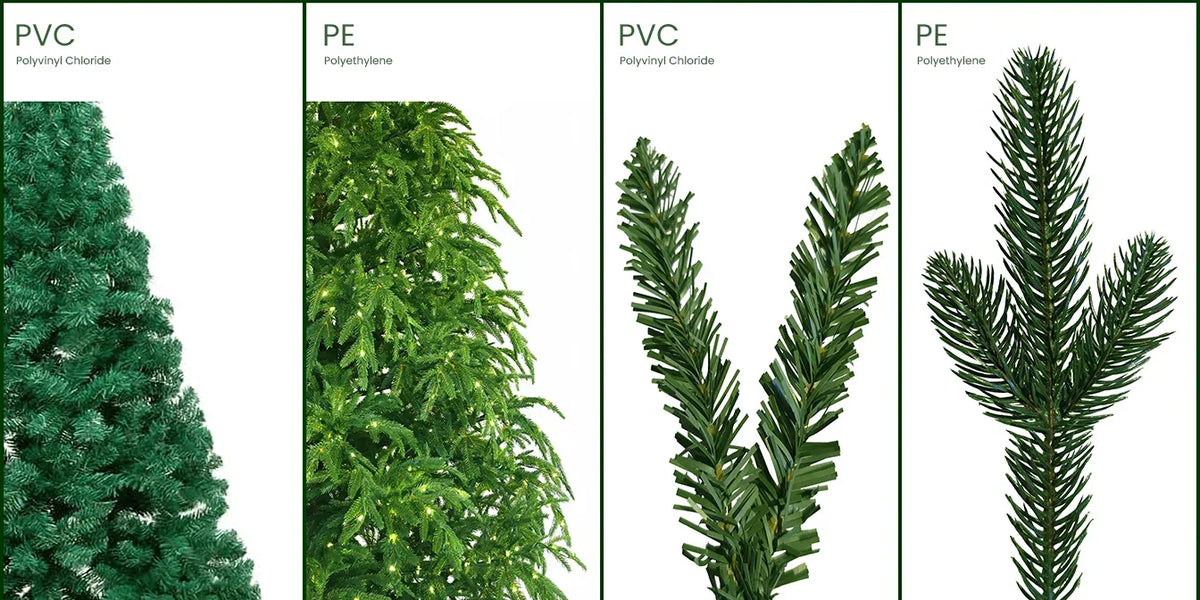
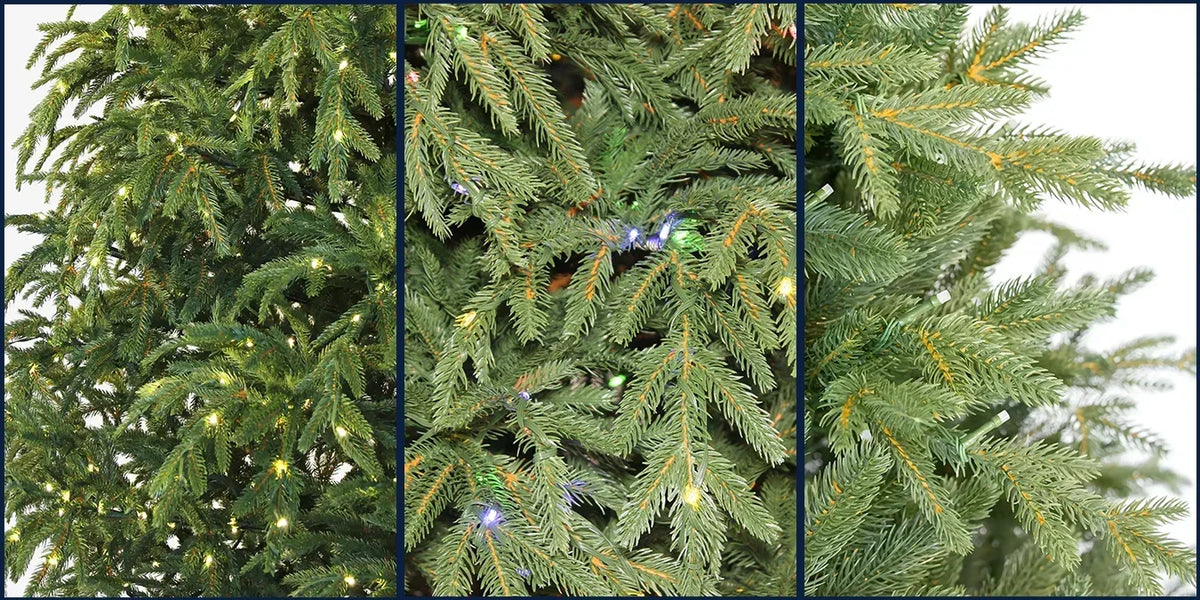
When shopping for realistic artificial Christmas trees, you’ll often see many advertised as a blend of PE (polyethylene) and PVC (polyvinyl chloride) needles. Brands often justify using PVC to add fullness or keep costs down. However, while PVC may bulk up the tree, it comes at the expense of realism. Flat, shiny PVC needles lack the three-dimensional structure and natural texture of PE, making the tree look less lifelike and more artificial, especially up close.
Here’s why.
1. PE and PVC Serve Completely Different Purposes
-
PE needles are mould-injected to mimic real evergreen tips. They have three-dimensional structure, natural variation, and realism you simply can’t achieve with flat materials.
-
PVC needles are cut from sheets of plastic, so they remain flat, shiny, and uniform — the opposite of what you see on a real Christmas tree.
When these two are blended, the PVC components inevitably dilute the realism of the PE tips.
2. Blended Trees Still Rely Heavily on PVC
Most brands describe their trees as a blend yet place the majority of the density in the PVC filler. That means:
-
The outer tips may be realistic,
-
But the bulk of the tree — the part that creates shape and fullness — still looks artificial.
Even with around 65% PE tips, the PVC content is still visually dominant once the tree is fully assembled.
3. PVC Has an Unnatural Shine
Real conifers have a soft, matte finish on their needles. PVC, on the other hand:
-
Reflects light in a sharp, unnatural way
-
Looks plasticky in both natural and artificial light
-
Shows up strongly in photos and video
When mixed with realistic PE tips, this shine is even more noticeable — creating contrast rather than cohesion.
4. PE Needles Create Natural Variation — PVC Cancels That Out
A lifelike tree needs:
-
Varied tip lengths
-
Natural tapering
-
Slight irregularity in direction
-
A round, sculpted needle profile
PE needles provide all of this. PVC doesn’t.
PVC strips are uniform, flat, and cut in straight lines — giving the tree an artificial “tinsel-like” look from many angles.
When combined, the PVC flattens the overall effect and the realism gets lost from a distance.
5. A Blend Doesn’t Capture the Structure of Real Branches
Real Christmas tree branches have:
-
A textured stem
-
Needles growing out in all directions
-
Natural spacing
PE moulded branches replicate this perfectly.
PVC, however, is usually wrapped around a metal stem in one direction — creating a broom-like shape that doesn’t resemble the radial fullness of a real branch.
No matter how much PE is added, the PVC core structure remains.
6. Premium Buyers Notice the Difference
For customers who care about realism — the colour gradients, the rounded needle shape, the way the tree behaves in light — PVC is an immediate giveaway. If someone is paying for a premium, long-lasting centrepiece, they don’t want half the tree looking obviously fake.
A 100% PE tree allows for:
-
Consistent realism from edge to core
-
Better shaping and fluffing
-
More natural branch profiles
-
A cohesive look from every angle
7. Longevity and Quality Improve With Full PE Construction
PVC needles are thin, prone to bending, and lose their shape over years. PE needles:
-
Hold their moulded structure
-
Resist flattening
-
Retain colour accuracy
-
Stay full and realistic after years of use
A blended tree usually ages faster because the PVC degrades visually long before the PE does.
Conclusion: If You Want True Realism, Go 100% PE
While a blend of PE and PVC may seem like a compromise between quality and affordability, it can’t match the authenticity of a fully PE tree. The presence of PVC — even in small proportions — undermines the realism, texture, and overall aesthetics.
For anyone looking to invest in a premium artificial Christmas tree that looks genuinely natural, a 100% PE tree remains the gold standard.
%20and%20PVC%20(polyvinyl%20chloride)%20needles.%20Brands%20often%20justify%20using%20PVC%20to%20add%20...)